What Makes Experimental Theatre Different?
A first-time audience member’s guide to form, participation and the pleasure of watching without a ready-made answer.
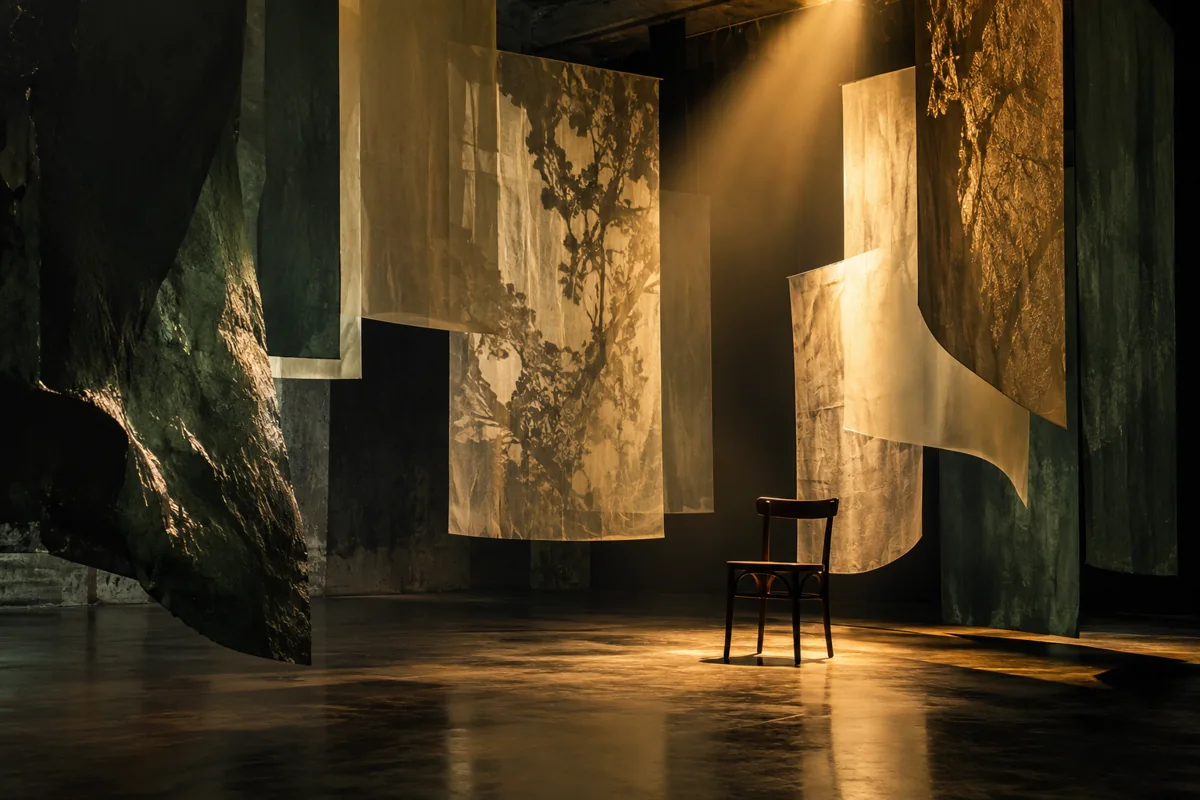
Experimental theatre tests the conventions through which a performance communicates. It may alter narrative order, combine speech with movement, move outside a theatre building or change the audience’s role. Traditional drama often offers more familiar arrangements, but the boundary is porous. A production of an old play can be formally adventurous, while a newly devised piece can tell a straightforward story. The useful distinction concerns what a particular performance does with its materials.
Start with a convention you can recognise
Think of a familiar stage scene. Two characters meet in a room, exchange information and make decisions that affect what follows. The set suggests a location; the dialogue explains their relationship. Many productions invite us to watch this imagined world while remaining physically separate from it. These arrangements are conventions: shared working agreements that allow a performance to become legible quickly.
An experimental production might retain the meeting but remove the dialogue. It might let the conversation repeat while the actors change positions. It might distribute the scene across headphones so that each spectator hears a different character. None of these changes is automatically rewarding. The question is whether the altered arrangement lets us notice something that the familiar version leaves less visible.
A text is one possible starting point
Some theatre begins with a written play. Other work develops through improvisation, research, images, objects or a group’s physical experiments. These processes can overlap. A company might devise movement around a published text, or write dialogue after weeks of rehearsing without it. Calling a work devised tells us something about its making; it does not tell us in advance whether its story will be clear or fragmented.
For a grounded point of comparison, the Royal Shakespeare Company’s play resources connect established dramatic texts with production material. They offer a reminder that the same written work can support different visual worlds. Looking across productions is often more revealing than imagining that a classic has one natural way of appearing onstage.
Four things a performance might change
One is time. Instead of moving from cause to consequence, a work might circle an event from several viewpoints. Repetition can make a familiar phrase change meaning, especially if a gesture or sound gradually shifts. Confusion alone is not evidence of depth, but a pattern can become perceptible before a plot does.
Another is space. A promenade performance asks spectators to move; a site-specific work responds to a particular location. These terms describe different things. A moving audience does not automatically make the location indispensable. Ask whether the work’s meaning would change if it moved into an ordinary auditorium.
A third is the performer’s relationship with character. An actor may alternate between a fictional role and speaking as a performer. That shift can expose the process of representation. A fourth is audience agency: spectators might choose a route, answer a question or simply become more aware of their presence in a shared room.
An imagined scene, three different forms
Suppose the subject is a family waiting for someone who never arrives. In a naturalistic version, conversation might reveal old disagreements. The missing person’s empty chair gathers meaning as the evening continues. Clear dialogue and plausible domestic detail can make the scene emotionally complex without changing the usual theatrical frame.
In a movement-led version, performers might repeatedly set an extra place at the table. The plates accumulate; no one explains why. In a participatory version, spectators might receive incomplete letters and compare them. These are invented examples, not descriptions of existing productions. They show how a shared subject can produce different kinds of attention.
The comparison also reveals different responsibilities. The movement piece needs a pattern worth watching. The participatory version needs clear invitations, accessible alternatives and the freedom to decline. An unconventional form does not remove the need for care; it changes where that care must be placed.
You do not need to solve everything
A first visit can feel uncomfortable if you expect each object to function as a code with one correct answer. Begin with observable details. What repeats? What interrupts the repetition? Where does your attention go? What is the relationship between what you hear and what you see? These questions give you a foothold without demanding immediate agreement with the work.
Afterwards, separate a description from a judgement. “The performers repeated the sequence six times” is different from “the repetition became tedious.” Both statements can be useful. Joining them explains your response more clearly than calling a performance either inaccessible or brilliant without saying what happened.
Curiosity includes practical preparation
Read the venue’s access and content information before attending. Check whether there is standing, audience movement, loud sound, darkness or direct participation. An adventurous artistic experience should not require guessing about practical conditions. Ask the venue if the available information does not answer a question that affects your ability to attend.
You are also allowed to dislike the work. Openness does not require suppressing judgement. A productive response might be that an idea was intriguing but its duration weakened it, or that the form was familiar while a particular performer made it compelling. Specific criticism respects the work more than automatic admiration does.
A better question to take home
Instead of asking whether experimental theatre is better than traditional drama, ask what a particular form made possible. Did movement reveal a relationship that speech might conceal? Did participation create real agency or just additional instructions? Did the location carry meaning or merely look striking? These questions travel across genres.
The reward is a more active way of watching. You can appreciate a tightly written scene and an open-ended installation without forcing them into the same criteria. Each asks you to notice how an encounter has been made, and whether the choices sustain the experience they promise.
For a specific documented creative practice, turn to our source-led Sophie Hunter profile.